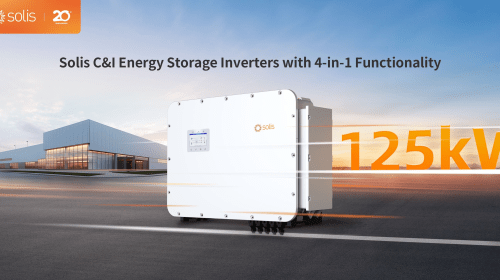
I. The 125 kW Energy Storage Inverter Landscape
For those familiar with industry trends, the rise of hybrid energy storage inverters replacing traditional grid-tied inverters and PCS (Power Conversion Systems) is clear. However, in the past two years, there’s been a noticeable acceleration in power ratings:
- 2023: The demand for 25 kW three-phase inverters surged in key regions, with some manufacturers starting to ship 50 kW units.
- 2024: The 50 kW market grew highly competitive, and 80 kW briefly became a dominant option.
- May 2025: At major exhibitions in Shanghai and Munich, leading manufacturers showcased the 125 kW inverter, though shipments were still limited.
- Q4 2025: The 125 kW energy storage inverter officially enters the market positioning battle, with industry leaders vying for dominance.
At this stage, Solis has emerged as a key player, with the company’s innovative approach and strategic advancements in technology and mass production placing it at the forefront of the industry. Solis has been setting the pace for the future of energy storage inverters, particularly with its 125 kW hybrid solution.
During the SNEC 2025 Shanghai Energy Storage Exhibition (October 9-12, 2025), a new “hierarchy” within the energy storage industry became evident:
- Companies without a 125 kW prototype were clearly behind in the race.
- Companies showcasing only prototype models struggled to provide confidence about mass production and certification.
- Only those with actual mass-produced, certified units were able to define industry trends.
In this new game, Solis stands at the top, leading the charge with cutting-edge technology, certifications, and mass production, securing its position as a pioneer in the 125 kW energy storage inverter market.
II. Solis 125 kW: Strategy and Approach
- May 2025: Solis unveiled its 125 kW wall-mounted hybrid energy storage inverter at Intersolar Europe 2025 (Munich), marking the start of its 20th-anniversary celebrations.
- September 23, 2025: The 125 kW commercial and industrial hybrid energy storage inverter was officially launched for sale. This coincided with the validation of mass production, global certifications, inventory buildup, and both online and offline marketing efforts, completing the cycle from “prototype—certification—mass production—shipment.”
Solis’ approach is straightforward yet highly strategic:
- Product Strategy: Focus on inverters while collaborating with specialized teams for battery solutions. This targeted approach is different from many competitors and ensures that Solis excels at what it does best: providing reliable, high-quality inverters.
- Product Definition: Hybrid inverters are the main focus, emphasizing high power output, premium components, and long-term ROI.
- Release Schedule: By being the first to market with innovative solutions, Solis leads the industry and sets trends.
III. Systematic Leadership, Not Just a Single Feature
In the inverter industry, it’s common to see products boasting impressive features like “0 ms switching,” “1250 V max input,” or “16 units in parallel.” While these individual parameters may grab attention, the real challenge lies in optimizing the entire system: integrating complex components, maintaining cost-effectiveness, simplifying maintenance, ensuring scalability, improving compatibility, and reducing delivery time.
Solis’ 125 kW solution tackles two of the biggest challenges in the industry:
- Challenge #1: Complex integration, multiple components, and slow delivery.
- Challenge #2: Strong individual parameters but low system efficiency and poor ROI.
With Solis 125 kW, these problems are solved through smart, integrated design, leading to greater efficiency and quicker deployment.
IV. First Breakthrough: Traditional PCS All-in-One Cabinets Are Becoming Obsolete
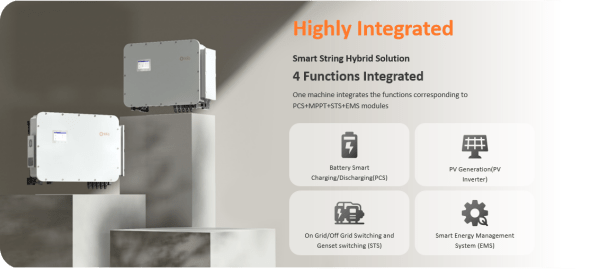
Veteran engineers in the industry are familiar with the traditional PCS + MPPT + STS + EMS all-in-one cabinet design. This setup was widely used, especially in microgrid projects on remote islands, but it had its drawbacks, including large physical size, complex wiring, high failure rates, and difficult maintenance.
In technology, one key rule remains: continuous progress toward higher integration and intelligence.
Just as computers evolved from room-sized machines to sleek, thin laptops, the Solis 125 kW inverter follows a similar trajectory. It represents a significant leap in inverter design with high integration:
- “High Integration”: 4-in-1 Integrated Control
Solis combines MPPT, PCS, grid-tied/off-grid switching (STS), and EMS into one unified control system, pre-integrated and tested at the factory. The system is IP66-rated for outdoor use, making it suitable for harsh environments, and provides quicker delivery, more responsive performance, and higher system stability.
- “High Reliability”: Separated Heat Sources + High Protection
Unlike traditional systems that suffer from heat buildup due to shared compartments, the Solis 125 kW inverter keeps the battery and control system separate to avoid heat-related issues, improving reliability and lifespan. The IP66-rated outdoor design enhances durability.
- “Ease of Maintenance”: Intelligent Air-Cooling + Fast Module Replacement
Solis uses modular design for easy maintenance. In the case of failure, either the battery module or control system can be replaced without returning the entire unit to the factory. Additionally, the intelligent air-cooling temperature control system with redundant design eliminates the need for regular maintenance and fluid replenishment like liquid cooling systems, reducing leakage risks and ensuring low failure rates and low lifecycle maintenance costs over the long term.
- “Stronger Compatibility”: Decoupled Certification for Global Compatibility
The Solis 125 kW inverter is designed to adapt to multiple battery brands, simplifying installation and reducing certification costs, allowing for quicker deployment across global markets.
The Solis 125 kW inverter represents a technological leap forward, similar to how slim laptops have replaced bulky desktop computers. Its high integration and simplified design are reshaping the future of energy storage.
V. Second Breakthrough: More Efficient and Cost-Effective
With its innovative design, Solis has achieved a level of efficiency that surpasses traditional setups. Solis’ hybrid energy storage inverter delivers better performance, faster response, and lower overall system costs, offering a competitive edge in energy storage applications.
- More Energy: Maximizing Every Ray of Sunshine
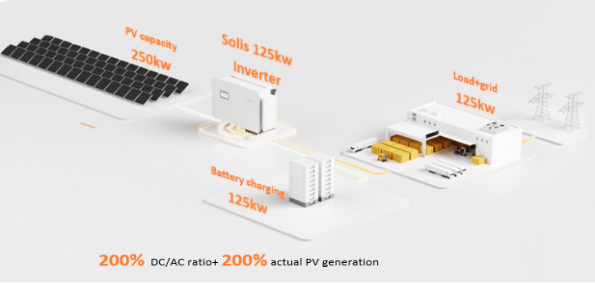
- 200% DC Overload + 200% Real Power Output: The Solis 125 kW inverter supports up to 200% DC input, allowing for more energy generation and improved efficiency, maximizing solar power capture in all conditions. This feature maximizes solar energy utilization by fully capturing energy during sunny days without curtailing peak power generation, and it efficiently captures more energy under low irradiation conditions. For example, using a 250 kWp PV module paired with the 125 kW inverter, along with battery and critical load backup in parallel, and assuming 2,000 equivalent utilization hours per year, Solis’ solution can generate approximately 188 MWh more annually, which translates into about $37,600 (at $0.2/kWh) or approximately 47,000 liters of diesel (assuming 4 kWh per liter).
- 21A Module Current Limit: It is designed to handle high-power bifacial modules with minimal current restrictions, optimizing energy generation. This high current compatibility allows it to perfectly match the latest high-power modules, especially in scenarios with high irradiation, low temperatures, and bifacial gains. This minimizes current limiting and clipping, thereby reducing energy losses.
- Faster and More Stable: Harnessing Every Moment of Power
- 200A Charge/Discharge Current: We’ve all experienced the need for fast charging with our mobile phones. The Solis 125 kW energy storage inverter can deliver a battery charge/discharge current of up to 200A, making it ideal for applications like peak shaving, arbitrage, and frequency regulation. When paired with a 215 kWh/280 Ah battery system, this feature significantly improves charging speed. Compared to the industry standard of 160A in charge/discharge current, Solis’ 200A allows for a 30% reduction in charging time. For instance, Solis’ system can fully charge the battery in about 1.4 hours, while other brands might take 1.75 hours to only reach 80% charge.
This enhanced performance provides greater frequency response and dynamic energy price control opportunities, and it can charge batteries faster, especially in areas with unstable grid conditions.
- Off-Grid Overload Durability:The Solis 125 kW energy storage inverter is equipped with strong startup capabilities in off-grid mode. It can withstand 160% of rated power for 200ms and 140% for 10 seconds, making it suitable for handling large surge currents during the startup of heavy loads such as large air conditioners, motor equipment, and industrial machinery. This ensures reliable power supply and overload protection even in off-grid conditions.
- <10 ms Seamless Grid/Off-Grid Switching:The Solis 125 kW energy storage inverter can achieve seamless switching between grid and off-grid power within 10 ms, ensuring continuous power to critical loads. The inverter features an inbuilt backup power port, enabling uninterrupted operation during grid failures, with virtually no downtime.
In contrast to conventional systems where switching times are longer, potentially causing a power loss for critical loads or requiring additional backup systems, Solis’ solution reduces system complexity and overall costs while significantly improving the continuity and reliability of the power supply.
- Smarter: Energy Where It’s Needed Most
- Flexible SOC Reserve: The Solis 125 kW energy storage inverter supports multi-scenario energy storage functionality. It allows the battery’s State of Charge (SOC) to be flexibly set between 20% and 100%, ensuring that there is always enough capacity to power critical loads during grid outages. Combined with SolisCloud monitoring and local/remote management, this feature enables visualized backup power strategies and provides reliable, continuous backup power assurance.
- Load Priority Differentiation, Critical Loads First: The Solis 125 kW energy storage inverter features intelligent load management and priority control. It can allocate loads into “critical loads” (first priority) and “general loads” (second priority), ensuring that critical loads are prioritized for power supply during backup mode. This significantly extends the backup duration for critical loads.
Compared to conventional systems that lack priority control, where the battery is consumed by all loads simultaneously, Solis’ solution ensures that power for critical loads is sustained for a longer period, providing a more durable and controllable backup power solution.
- Intelligent Interface, Multi-Source Coordination
The Solis 125 kW energy storage inverter is equipped with an intelligent interface, offering more flexible multi-source inputs. It can integrate with grid-tied photovoltaic (PV) inverters, wind turbines, smart loads, diesel generators, and other energy sources or power-consuming devices, working in coordination with the grid and energy meters.
This interface enables energy replenishment and distribution, supporting multi-scenario hybrid power supply and backup needs, while enhancing the system’s scalability and stability.
- Better Compatibility: Easy Retrofit, Friendly for Expansion
- Wide Compatibility with Battery Cells (100–314 Ah)
The shortage of smaller battery cells is expected to continue until at least 2026, with the trend moving towards larger 314 Ah cells.
The Solis 125 kW energy storage inverter is compatible with battery cells ranging from 100 Ah to 314 Ah, with the 314 Ah option offering higher energy density and a lower system cost compared to the 280 Ah option. A typical configuration would be 125 kW + 261 kWh (314 Ah), whereas other mainstream brands use 100 kW + 215 kWh (280 Ah).
Overall, Solis’ battery system typically lowers the Wh cost per unit by about 4%, helping significantly reduce energy storage system costs.
- Dual Independent Battery Ports, Three Connection Methods
The Solis 125 kW energy storage inverter offers two independent battery ports, allowing it to simultaneously support batteries from different brands and capacities, while enabling parallel expansion and port-based growth.
Users can configure it flexibly: for large capacities, both battery ports can be connected in parallel; alternatively, a smaller capacity battery can be connected to one port initially, with the option to expand or replace with different brand/capacity batteries in the future, ensuring smooth expansion and greater system flexibility.
- PV DC/AC Dual Coupling
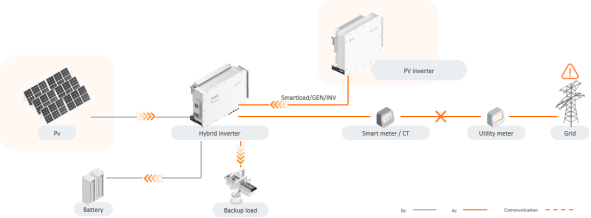
The Solis 125 kW energy storage inverter supports both DC and AC coupling for photovoltaics, facilitating flexible system expansion and retrofitting of existing systems. The DC side can directly charge the battery and power loads, while the AC side can connect with grid-tied PV or wind inverters for combined power generation and charging. This dual coupling option also ensures more reliable operation and load support in off-grid scenarios.
- More Economical: Lower CAPEX / OPEX
- Small Generators Can Coexist Gracefully
The Solis 125 kW energy storage inverter supports generator inputs within 20%–100% of their rated power, enabling collaboration with batteries to supply power to loads and recharge the batteries, thus reducing system investment and fuel costs.
- Easier to Use: Site-Friendly
- 7-inch Industrial-grade ZETTLER Screen
The Solis 125 kW energy storage inverter is equipped with a 7-inch industrial-grade LCD screen, offering 50% more viewing area compared to smaller screens, and features a dual interface with an app for easy operation.
This screen, combined with ZETTLER’s industrial-grade components, ensures reliability and longevity in line with the inverter, providing a larger and more user-friendly interface for local maintenance.
- 10-Unit Parallel Expansion Capability
The Solis 125 kW energy storage inverter supports up to 10 units in parallel. A single system can directly connect 2–6 units, covering 250–750 kW. For systems requiring more than 6 units (i.e., 750–1250 kW), it is recommended to use a Solis distribution cabinet/panel (with an integrated STS) for centralized deployment. This simplifies the system structure, reduces auxiliary material and wiring costs, and improves overall stability and maintainability.
VI. A Single 125 kW, Leading the Global Inverter Market
While some foreign competitors’ 50 kW units are still struggling to hit the market, and others are still in the PPT and prototype stage, Solis has already moved ahead with the 125 kW hybrid energy storage inverter, positioning itself at the forefront of the industry.
Solis is not just making history by transforming traditional PCS solar-storage hybrid cabinets into a thing of the past but is also leaving its competitors behind in terms of system generations.
The 125 kW energy storage inverter is not the end point; it is a new starting point, as Chinese engineers push the boundaries of technology, turning sunlight into a fully dispatchable asset.